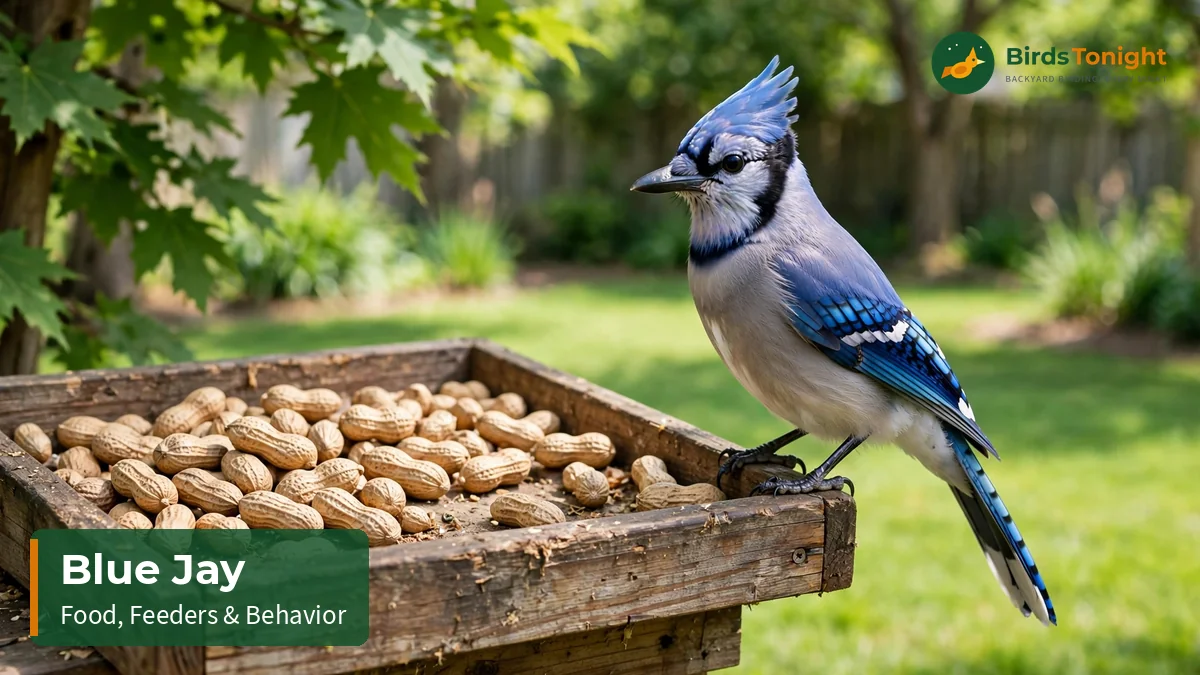
Blue Jay: How to Identify, Feed and Understand This Bold Blue Bird
The blue jay is one of the easiest birds to notice in an eastern backyard. It is big, bright blue, and loud, and it rarely visits a yard in silence. For many people, it is the bird that announces itself before it lands.
This guide shows how to identify a blue jay and why its blue color is not what it seems. It also covers the sounds it copies, the food it loves, and the feeders that work best. By the end, you will know how to welcome this clever bird to your yard.
Some people find jays too loud and pushy at the feeder. Watch them for a season, though, and you may change your mind. Few backyard birds are smarter, bolder, or more fun to follow.
How to identify a Blue Jay
The Blue Jay (Cyanocitta cristata) is a medium-sized songbird, about 9 to 12 inches long from beak to tail. Its most famous feature is the pointed crest on its head, which it can raise or lower like a signal flag. A raised crest often means the bird is excited, alarmed, or feeling bold.

The back, wings, and tail are a bright sky blue, marked with black bars and white spots. The face and belly are clean white, and that contrast makes the blue look even stronger. Males and females look the same, so you cannot tell them apart by color alone.
Look for the black necklace that runs across the throat and up the sides of the head. The bill is strong, straight, and black, built for cracking hard shells and carrying nuts. In flight, the bird shows broad wings and slow, steady wingbeats, and it often glides between trees.
Young blue jays look like smaller, duller copies of their parents. Their blue is softer and their black markings are less crisp. By their first autumn, they wear the same bold pattern as the adults.
The secret behind the blue color
Here is the surprise: a blue jay’s feathers hold no blue pigment at all. The only pigment in the feathers is brown, the same plain color found in many dull birds. The blue you see is a trick of light, not a dye in the feather.
Inside each feather, tiny structures are arranged in a special pattern. When sunlight hits the feather, those tiny structures scatter blue light back to your eyes and absorb the other colors. Scientists call this structural color, because the color comes from the structure of the feather itself.
You can prove it with a single feather that a jay has dropped. Hold the feather up so the light shines through it, and the blue is gone, leaving a dull gray or brown. Crush the feather and you break the tiny structures, and the blue fades in the same way.

This blue also behaves in a steady way. It does not flash or change color as the bird turns, the way the throat of a hummingbird does. From any angle, in sun or shade, the feather keeps its calm sky blue.
Voice and mimicry
The classic sound of this bird is a loud, harsh jay, jay call that carries across a whole neighborhood. Blue jays also whistle, click, gurgle, and chatter, and a close flock can sound like a busy party in the trees. They are rarely quiet for long, and other birds seem to listen when a jay calls.

Jays are skilled mimics, and their favorite copy is the scream of a hawk. A hungry jay at a feeder may let out a perfect Red-shouldered Hawk call, and every small bird nearby dives for cover. The jay then drops down and feeds alone, in peace, at the emptied feeder.
Bird experts think the hawk copy can also warn other jays of real danger, or test whether a hawk is nearby. Whatever the reason, the trick shows how smart this bird is. Jays also copy other bird sounds, and tame birds have even learned a few human words.
Jays also serve as the alarm system of the yard. Their loud scolding warns deer, squirrels, and smaller birds that a cat, owl, or hawk is near. When the jays suddenly go quiet, it can mean the danger has moved very close.
What Blue Jays eat
Blue jays eat almost anything, but nuts and seeds sit at the top of the list. In the wild, acorns are a favorite, and a yard with an oak tree will draw jays for years. They also eat other nuts, corn, berries, and many kinds of insects.
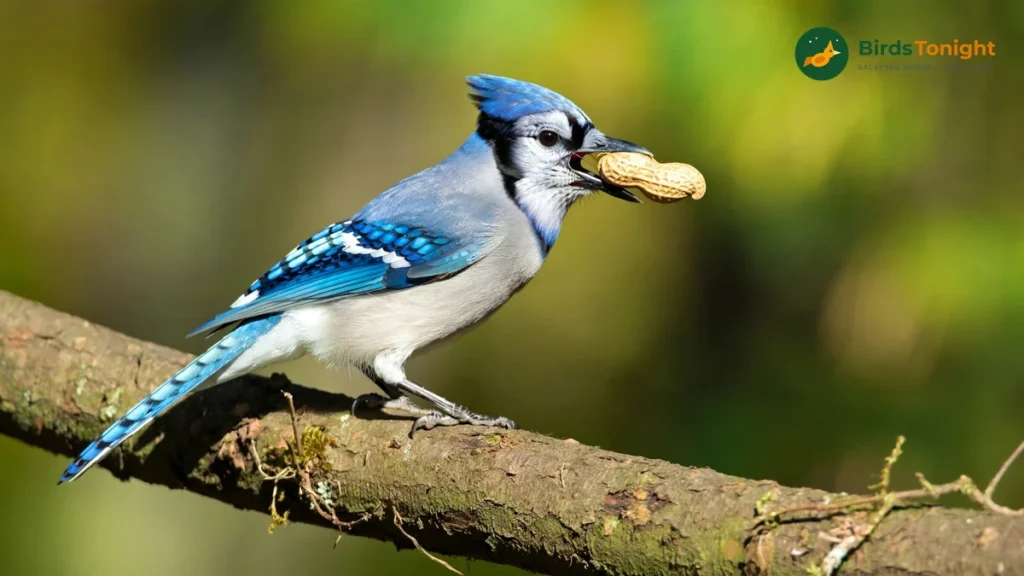
At a feeder, whole peanuts in the shell are the number one treat. A jay will weigh a peanut in its bill, swap it for a heavier one, and fly off to open it on a branch. Black-oil sunflower seeds and suet are also popular, and jays visit both with great energy.
To open hard food, a jay holds the nut under its feet and hammers it with its strong bill. It eats some food right away and carries the rest off to hide for later. Now and then a jay will take eggs or nestlings from other nests, but seeds and nuts make up most of its diet.
In summer, jays add more insects to the menu, including caterpillars, beetles, and grasshoppers. Parents feed insects to their young, since growing chicks need protein more than seeds. A shallow birdbath also draws jays, which love a loud, splashing bath.
Best feeders for a Blue Jay
Size is the key to feeding this bird. A blue jay is big and heavy for a songbird, and it likes to land on a flat surface and face its food. Small tube feeders fail jays for a simple reason: the ports are tiny and the perches are too short for their feet.
Platform and tray feeders are the best choice, because they give a jay room to land, hop, and pick through the food. A hopper feeder with a wide ledge also works well. Set the feeder in the open if you can, since jays like a clear view of the yard while they feed.
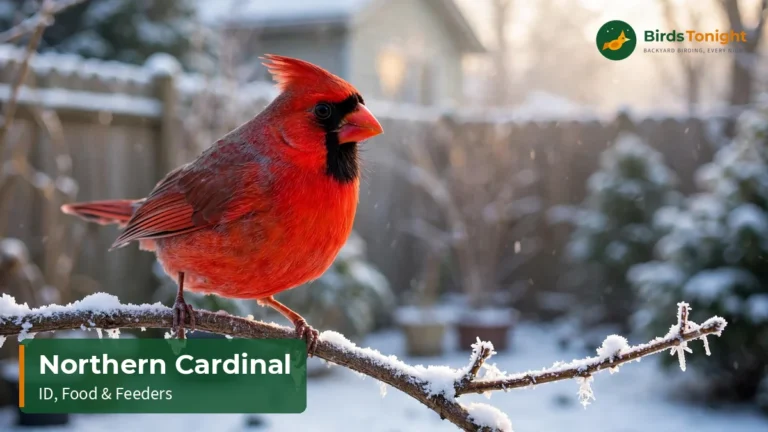
For peanuts, use a peanut feeder, such as a wire mesh tube or a metal wreath that holds whole peanuts in the shell. If cardinals already visit your yard, you are halfway there, because jays and northern cardinals share a love of sunflower seeds and roomy feeders. Keep the tray clean, and wash it often so old seed does not spread disease.
Place the feeder near shrubs or a tree, so jays can land, look around, and dash to cover if a hawk appears. Expect squirrels to raid the peanuts too, since few yard animals can resist them. Refill the tray early in the morning, when jays do much of their feeding.
How Blue Jays behave
In autumn, a blue jay turns into a flying gardener. It fills a special stretchy pouch in its throat with acorns, adds one more in its bill, and flies off to bury them one by one in the soil. A single jay can hide thousands of acorns in one fall season.
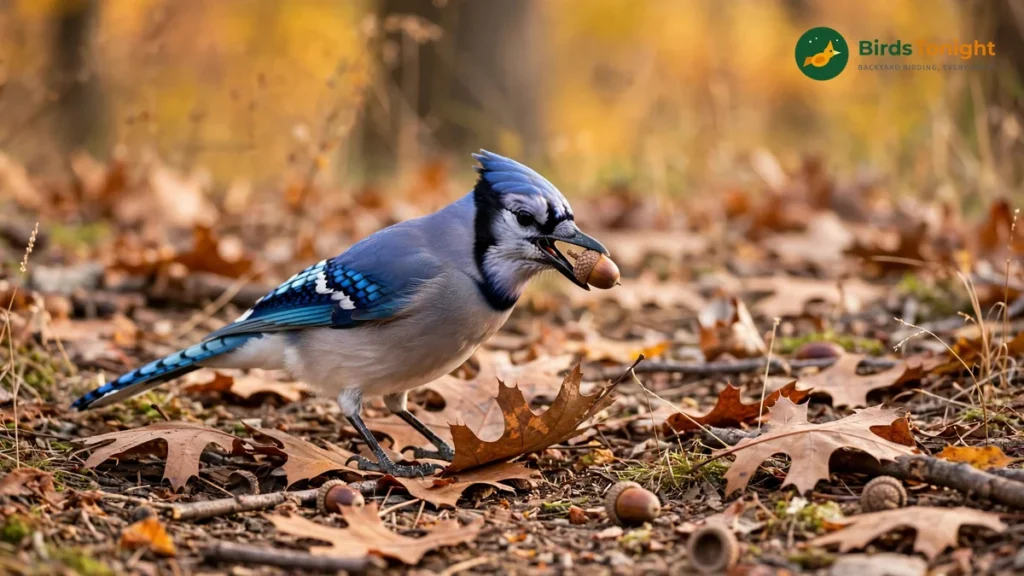
The bird remembers most of its hiding spots and digs the acorns up through the winter. But it forgets some, and those forgotten acorns sprout where they were buried. In this way, blue jays have helped plant new oak trees and spread oak forests for a very long time.
Jays are social and noisy, and family groups often travel and feed together outside the breeding season. A group of jays will mob an owl or a hawk, calling loudly until the hunter gives up and leaves. Pairs often stay together for years, and the birds watch each other closely and learn fast.
At a crowded feeder, a jay may flare its crest and open its bill to claim the best spot. Smaller birds usually step aside, but the jay rarely stays long. It grabs a peanut or a bill full of seeds and leaves, and the small birds return.
Lookalikes: the Steller’s Jay
In the West, the blue jay’s close cousin takes its place. The Steller’s Jay has a long crest like the blue jay, but its head, neck, and upper body are dark sooty gray to black. Its lower body, wings, and tail are a deep rich blue, and it has no white face.
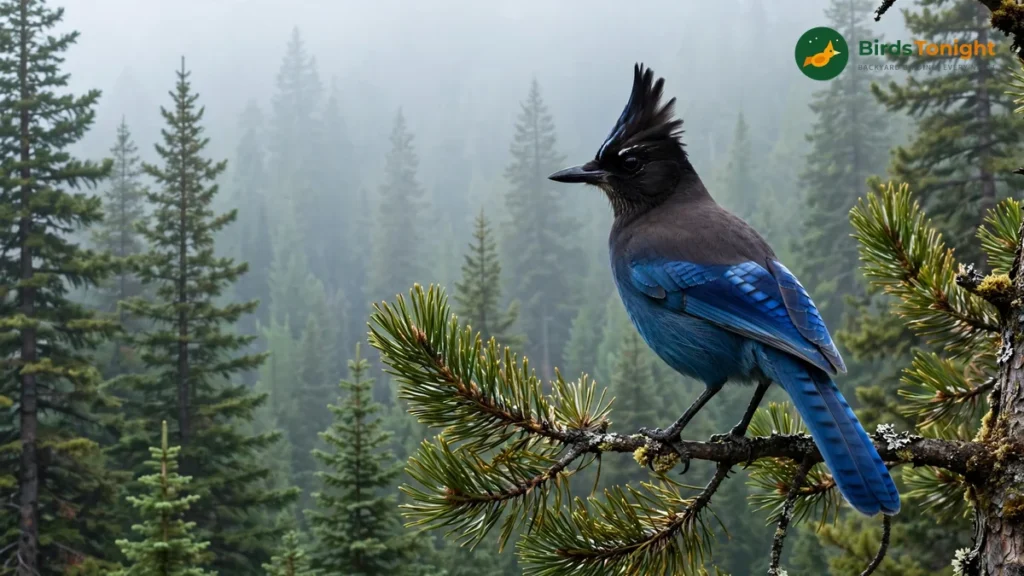
Steller’s Jays live in pine and mountain forests of the West, and they are just as loud and bold at campsites and picnic tables. If your jay has a dark head and no white on its face, you are looking at a Steller’s Jay. East of the plains, the bright white-faced bird is the blue jay.
The two species rarely meet, since their ranges touch only in a few places. Your location is the fastest clue of all. A crested blue jay in the East is a blue jay, and a dark-headed one in the western mountains is a Steller’s.
Blue Jay questions, answered
Are Blue Jay feathers really blue?
No pigment in the feather is blue. Tiny structures inside the feather scatter blue light to your eyes, which is why a feather looks gray or brown when light shines through it. The color lives in the light, not in the feather itself.
Why do Blue Jays copy hawk calls?
A hawk copy scares smaller birds away from a feeder, so the jay can feed alone. The call may also warn other jays or test if a real hawk is near. Either way, it is one of the smartest tricks you will hear in a backyard.
What food brings Blue Jays fastest?
Whole peanuts in the shell work faster than almost anything else. Offer them on a tray feeder or in a peanut feeder, and jays will learn the spot within days. Sunflower seeds and suet are good backup foods.
Do Blue Jays migrate?
Some do and some do not, and the pattern changes from year to year. Northern birds may move south in some winters and stay in others, and no one fully understands why. Many jays you see in winter are the same birds that nested near you in spring.