

House Finch vs Purple Finch: How to Tell Them Apart
A red finch lands on your feeder and you freeze for a second. Is it a House Finch or a Purple Finch? The two birds look a lot alike at first glance, and birders mix them up all the time.
The good news is that you do not need to be an expert to tell them apart. With house finch vs purple finch, a few clear marks settle the question in seconds. This guide walks you through each mark, one step at a time.
The quick answer
If you only have ten seconds, look at the color and the belly. A male House Finch wears orange red on the head and chest, with thick brown streaks down the belly. A male Purple Finch glows raspberry red all over, and his belly stays much cleaner.
Females are easier than most people think. A female House Finch has a plain face with soft, blurry streaks. A female Purple Finch has a bold white stripe over the eye that jumps out at once.
The table below sums up the main marks. Keep it in mind the next time a red finch drops in. Then read on for the full story behind each mark.
| Mark | House Finch | Purple Finch |
|---|---|---|
| Color of the male | Orange red | Raspberry red |
| Bill | Upper bill curves down | Straighter and more pointed |
| Streaks | Heavy brown streaks on the belly and sides | Light streaks, cleaner underparts |
| Tail | Shallow notch | Deep notch |
| Face of the female | Plain face, no bold marks | Bold white stripe over the eye, dark jaw patch |
Male vs male, step by step
Start with the color. On a House Finch, the red leans orange, and it sits in clear patches on the head, the brow, and the upper chest. The back stays brown and streaky, like the color never quite spread that far.

On a Purple Finch, the color looks like raspberry wine. It washes over the whole head, down the back, and along the sides. Even the wings carry a soft pink tint, so the bird looks stained with color from head to tail.
Next, look at the belly. A male House Finch has heavy brown streaks that run down the sides and across the lower belly. Those streaks are bold and easy to see, even from a few steps away.
A male Purple Finch keeps his underparts much cleaner. You may see a few faint streaks on the sides, but the belly looks pale and open. If the belly looks tidy, think purple.
Light can trick you, so judge the color with care. A House Finch in bright sun can look quite red for a moment. Look at where the color stops, since the House Finch keeps it in patches while the Purple Finch spreads it wide.
Last, check the shape of the head and back. The House Finch looks a bit scruffy, with a smaller head and a long, streaky back. The Purple Finch looks fuller and rounder, and the color seems to glow through the whole upper body.
The bill test
When the color leaves you unsure, look at the bill. The House Finch has a thick bill built for cracking seeds. Its top half, called the upper mandible, curves down in a smooth arc, almost like a tiny parrot beak.

The Purple Finch bill looks straighter and sharper. The top edge runs in a flatter line and ends in a clear point. Once you see the two bills side by side in photos, the curved one and the straight one are hard to mix up again.
Try this test at your feeder. Watch the bird from the side as it picks up a seed. A curved, rounded bill points to House Finch, and a straight, pointed bill points to Purple Finch.
The bill test works on the females too. A plain faced bird with a curved bill is a female House Finch, even before you study her streaks. A bold faced bird with a straight bill is a female Purple Finch.
Female vs female
Many birders skip the females, but the females are often the easiest pair to split. Both are brown and streaky, so the face is where the answer hides. Slow down and look at the head first.
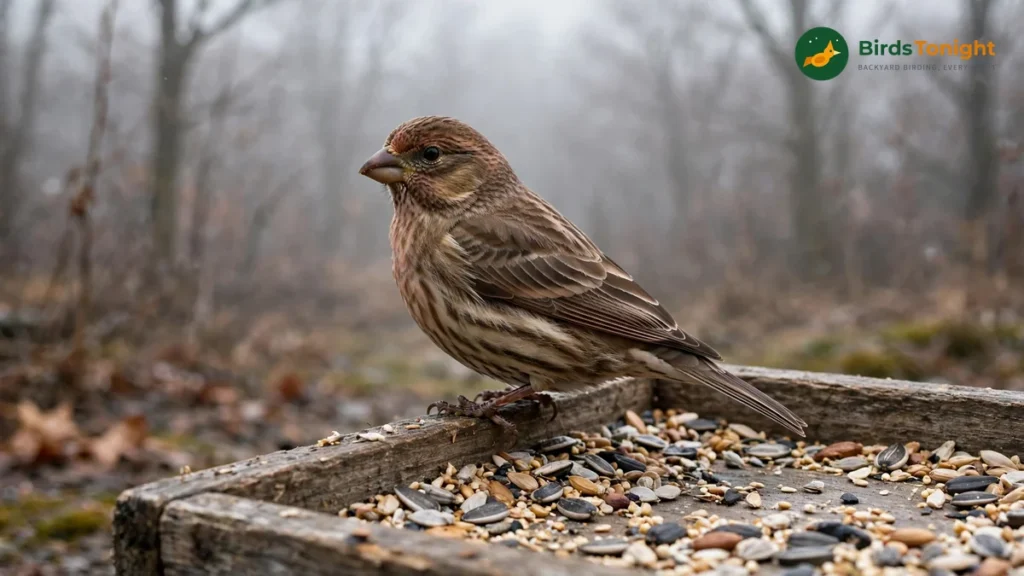
A female House Finch has a plain face with no strong marks at all. Her streaks look soft and blurry, as if someone smudged them with a thumb. The whole bird gives a gentle, plain brown feel.
A female Purple Finch wears a bold white stripe over the eye. Below it sits a dark patch on the jaw, and the streaks on her body look crisp and dark. That strong face pattern shows up even in poor light.

Body shape backs up the face marks. The female Purple Finch looks a touch stockier, with a bigger head and a stronger bill. The female House Finch looks slimmer and plainer from every angle.
Tail and flight
The tail gives one more clue when the bird turns away. A Purple Finch tail has a deep notch in the middle, like a shallow V cut into the tip. A House Finch tail looks flatter, with only a small notch.

In flight, both birds bounce up and down in the rolling way most finches do. The Purple Finch often gives a sharp, dry tick call as it flies. The House Finch sings a long, cheerful warble from a rooftop or a wire, and it sings in every month of the year.
You will not use the tail on every bird. Some views are too short, and some tails hide behind a branch. Treat it as a bonus clue that supports the color, the bill, and the face.
Where and when you see each
Place and season help a lot. House Finches love towns, suburbs, and farmyards, and they crowd feeders all year in most of the United States. If a red finch lives in your neighborhood all year, it is almost surely a House Finch.
Purple Finches breed in the cool forests of the north and the west. Most of them visit feeders in the east and the middle of the country only in winter. Some winters bring many, and some winters bring almost none, so a surprise visit feels special.
Along the Pacific coast, Purple Finches stay through the whole year. They nest in tall trees near the coast and drift down to lowland feeders in the cold months. Even there, the raspberry color and the clean belly give them away.
Purple Finches move south in late fall, and most feeder visits in the east happen from November to March. A red finch that shows up with the first cold snap is worth a close look. House Finches, by contrast, rarely travel far from the place where they hatched.
Habitat is a soft clue, not a hard rule. A Purple Finch can drop into a city feeder on a cold morning, and House Finches wander into country yards too. Use place and season to support what the color, bill, and face already told you.
Feeder tips to attract both
Both finches love black oil sunflower seeds. Fill a tube feeder with sunflower seeds and you give each bird a reason to stop. Tube feeders suit their small feet and keep the seed dry in snow and rain.
Add a second tube with nyjer seed if you can. Finches pick at nyjer in calm groups, and a mixed flock gives you side by side views. Those close comparisons are the fastest way to learn the marks in this guide.

On a busy winter day, the same feeder may also host a Northern Cardinal, a much bigger red bird with a tall crest. Our cardinal guide shows how to feed and enjoy that bold visitor too. Keep your feeders clean, wash them with hot water every two weeks, and rake up old seed shells under the pole.
Put the feeders where you can watch them from a warm window. Morning light shows the reds at their best and makes the streaks easy to read. A few calm minutes of watching beats a quick photo every time.
Frequently asked questions
Can a male House Finch look yellow or orange instead of red?
Yes, and it happens a lot. The red color comes from the food the male eats while he grows new feathers. Males that eat fewer rich red foods turn orange or even yellow, but the streaky belly and the curved bill stay the same.
Do House Finches and Purple Finches visit the same feeder?
They do, mostly in winter. Watch the flock bird by bird instead of as one group. The raspberry males with clean bellies are Purple Finches, and the streaky orange red ones are House Finches.
Which finch is more common at backyard feeders?
In most towns and suburbs, the House Finch wins by a wide margin. Purple Finches show up in smaller numbers and mostly in the colder months. A winter flock with a few Purple Finches mixed in is a treat worth a photo.
What is the fastest way to tell the females apart?
Look at the face. A bold white stripe over the eye means Purple Finch. A plain face with soft, blurry streaks means House Finch.