
Birds Hitting Windows: How to Stop Window Strikes for Good
Almost every bird lover has heard that dull thud against the glass. You hurry to the window and find a small bird sitting stunned on the ground below.
Window strikes are one of the biggest killers of backyard birds. Scientists estimate that hundreds of millions of birds die this way in the United States each year, and the true number may reach up to a billion.
The good news is that this problem has clear fixes. Once you know why birds hit glass, you can make your windows safe in a single weekend.
Why birds fly into windows
Glass tricks a bird in two main ways. The first is reflection: on a bright day, a window mirrors the sky, trees, and shrubs so well that it looks like open habitat.
The second trick is see-through glass. When a bird can look through one window and out another, or spot a houseplant inside, it sees what looks like a clear path and flies straight at it.
A bird’s eyes are built to spot food and danger, not invisible walls. Nothing in nature looks like glass, so birds never learn to fear it.
Young birds are at the highest risk of all. A bird that hatched this summer has never seen a house before, and it learns about glass only by hitting it, if it survives the hit at all.
The one rule behind every fix that works
Every fix that works follows one rule: the pattern has to sit on the outside surface of the glass. A pattern on the inside does little good, because the outer surface still reflects the sky like a mirror.
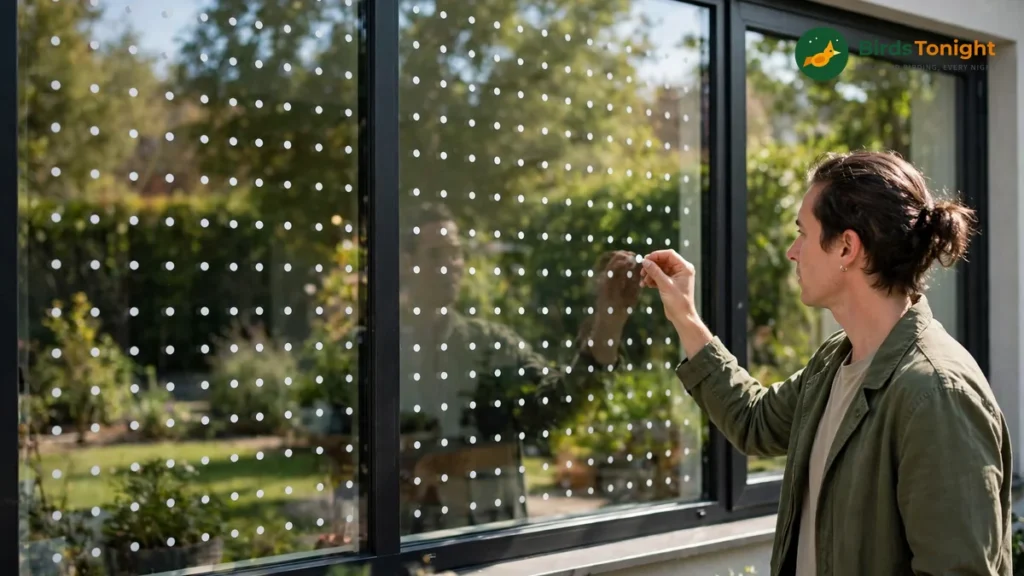
The marks also have to be close together. Space them no more than 2 inches apart in every direction, up, down, and across, so no gap looks big enough to fly through.
Birds aim for any opening that looks wider than their own body. If a gap is bigger than about 2 inches, many small birds will try to slip through it and hit the glass instead.
Think of the window the way a bird sees it. Stand outside on a bright morning and look at your own glass: if you see sky and branches instead of a wall, a bird sees a flight path.
This is why one or two stickers never work. A single hawk shape stuck in the middle of a big window leaves the rest of the glass looking open, and birds simply fly around the sticker.
Birds do not read a hawk silhouette as a warning sign. They treat it like a small dark patch and keep coming, so the window needs a full pattern, not a lone decal.
Fixes that really work
You have several proven ways to build that pattern. Pick the one that fits your windows, your budget, and the look of your home.
Decal and tape patterns. Decals and tape strips made for this purpose are the easiest place to start. Apply them across the whole outside of the window in rows or grids, keeping every gap at 2 inches or less, and they will last for years.
Tempera paint. Tempera paint is the cheapest fix of all, and it washes off with soap and water. Dab dots or paint lines on the outside glass with a small brush, again keeping the spacing tight, and redo it in minutes whenever it fades.

External window screens. A screen mounted on the outside of the window works two ways at once. It breaks up the reflection, and if a bird does fly in, the soft mesh acts like a net that cushions the hit.
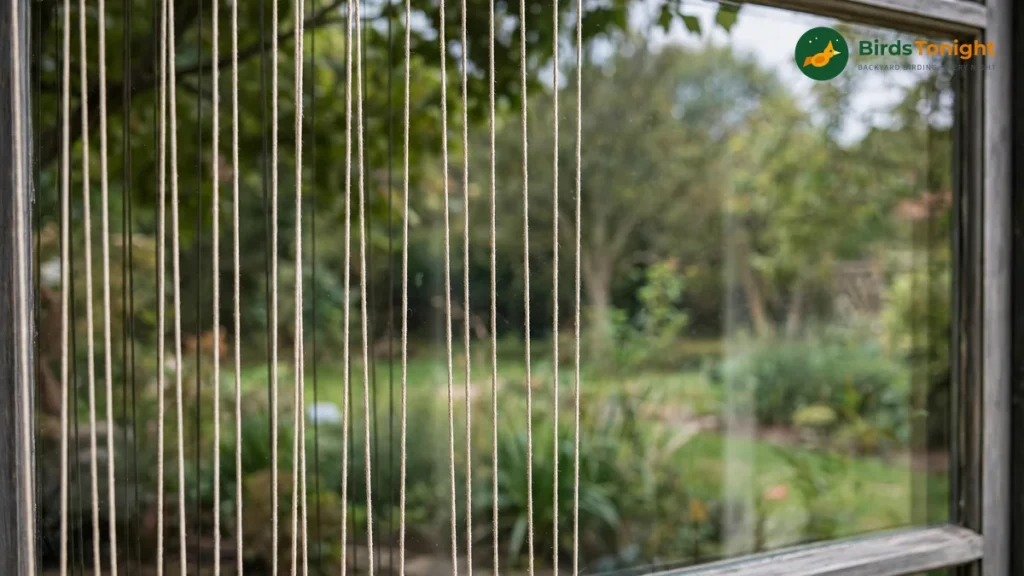
Hanging cords. Thin cords, often paracord, can hang in front of the glass from the top of the window, spaced a few inches apart. Birds see the curtain of cords and turn away before they reach the glass, and these hanging cord systems, often called bird savers, can be bought ready made or built at home.
Netting. Fine netting stretched a few inches in front of the window gives a bird a soft place to bounce off. Mount it on a simple frame so it stays tight and clear of the glass, and check now and then that it has not sagged.
Whole window marker treatments. Marker treatments cover the whole window with a pattern birds can see. You draw a tight grid right on the outside glass with a marker made for this job, and from inside the window still looks almost clear.
Start with the window that gets the most strikes, if you know which one it is. Treat that window first, watch it for a few weeks, and then do the other windows on that side of the house the same way.
Put feeders in the safe zones
Where you hang your feeders matters as much as the glass itself. Birds burst away from feeders at full speed when a hawk or a cat startles them, and a window in that flight path becomes a trap.
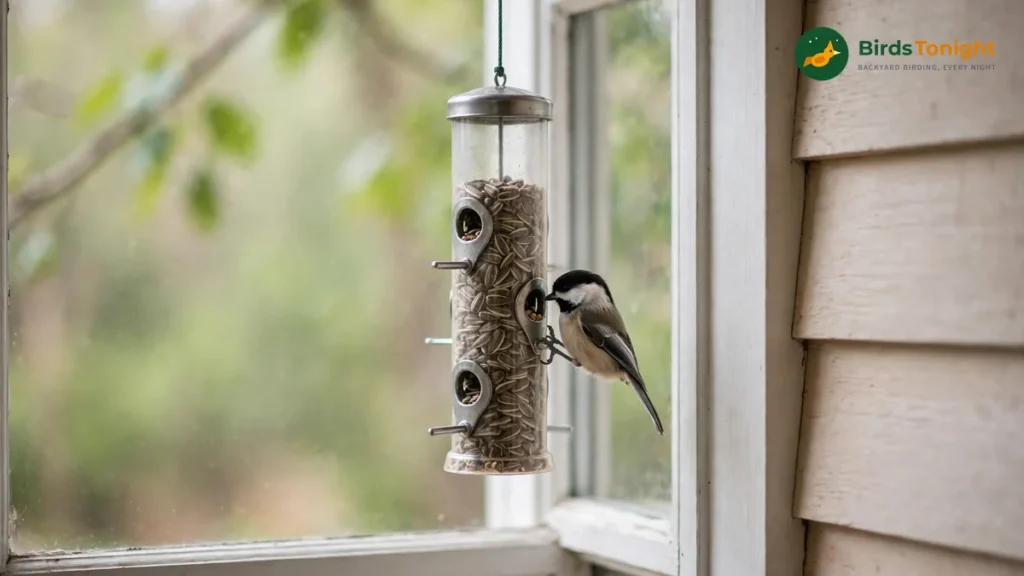
The safe choice is very close or very far. Set feeders within about 3 feet of the window, and a bird leaving the feeder cannot build up enough speed to hurt itself if it bumps the glass.
Or place feeders 30 feet or more from the house. At that distance, birds have room to turn and steer, and they are far less likely to aim at the window at all.
The danger zone is the space in between, roughly 3 to 30 feet out. If your feeder sits there now, moving it closer or farther away is one of the fastest free fixes you can make.
Window feeders that stick to the glass with suction cups are the closest option of all. Birds come and go at low speed, and the close up view from your chair may be the best seat in the house.
What to do if a bird hits your window
Even with good patterns, a rare strike can still happen. Act calmly and quickly, because a stunned bird on the ground is easy prey for cats and crows.
Gently lift the bird with a soft cloth and place it in a dark paper bag or a small box lined with soft cloth. Close the top so the bird cannot flap out, and set the bag or box in a warm, dark, and quiet place.
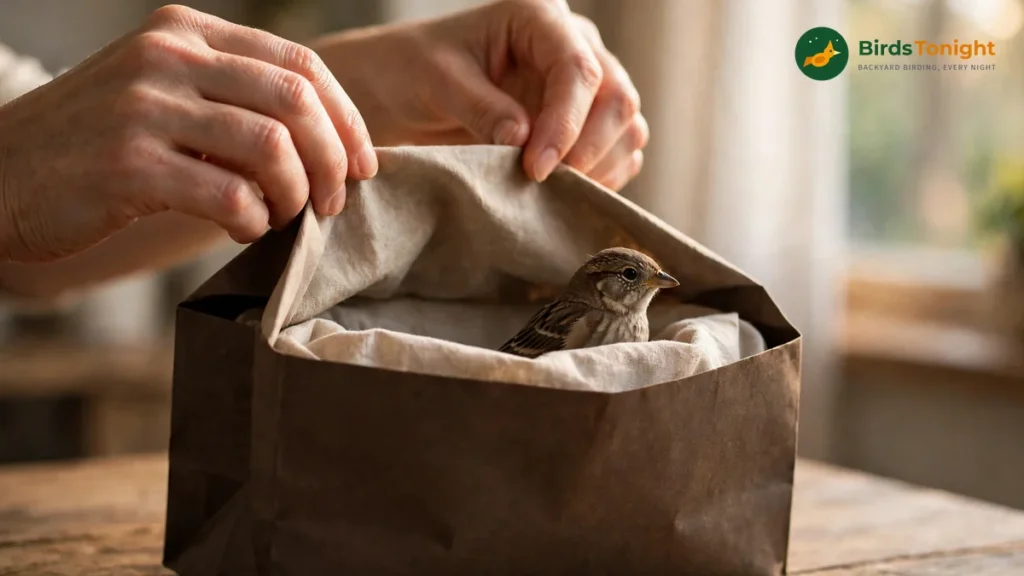
Do not give the bird food or water. A bird with a head injury can choke, and feeding it can do real harm.
Check on the bird after an hour or two. If it is alert and flies off strongly when you open the bag outside, it can go free.
If it cannot fly well, or it droops, tilts its head, or keeps its eyes closed, call a wildlife rehabilitator right away. Head injuries often look mild at first and then get worse, so expert care gives the bird its best chance.
Turn off lights on big migration nights
Windows are a danger at night too, above all during spring and fall migration. Bright outdoor lights pull night migrants off course and draw them toward lit houses and glass.
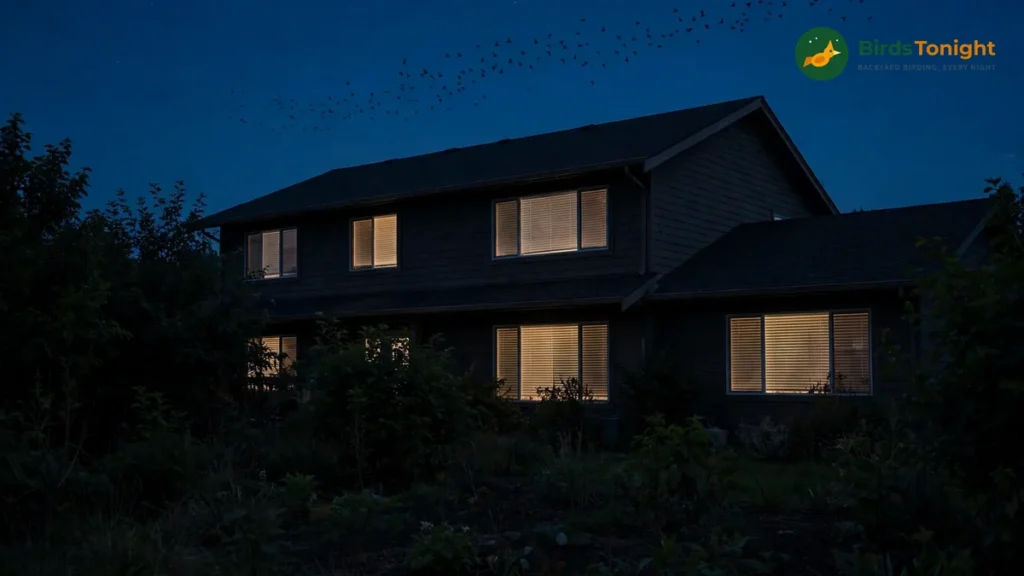
On heavy migration nights, turn off every outdoor light you do not need, and close the blinds on lit windows. You can check the forecast before bed with our guide on how to use BirdCast, so you know which nights matter most.
Porch lights on motion sensors are a kind middle ground. They stay dark most of the night and only switch on when a person walks up.
Frequently asked questions
Will one hawk sticker on my window stop strikes?
No, one sticker will not stop strikes. It leaves most of the glass looking open, and birds fly around it and hit anyway, so a full pattern with gaps of 2 inches or less is what turns birds away.
Do I have to treat the whole window?
Yes, any clear patch can still draw a bird in. Cover the full area that birds fly toward, from top to bottom, and check the glass from outside on a bright morning to spot any gaps you missed.
How long do window patterns last?
Decals and tape made for this job often last several years. Tempera paint may need a fresh coat after heavy rain or a window wash, but it takes only minutes to redo.
A bird hit my window and flew off. Is it fine?
Not always, and there is no way to be sure from a quick look. Some birds fly off with head injuries that only show up hours later, which is why a quiet rest in a dark bag before release is the safer path whenever you can catch the bird gently.
Safe windows do not take much money or skill. Pick one fix, cover the glass well, and your yard becomes a place where birds can feed and fly without fear, and every window you treat can save birds for years to come.